





Introduction
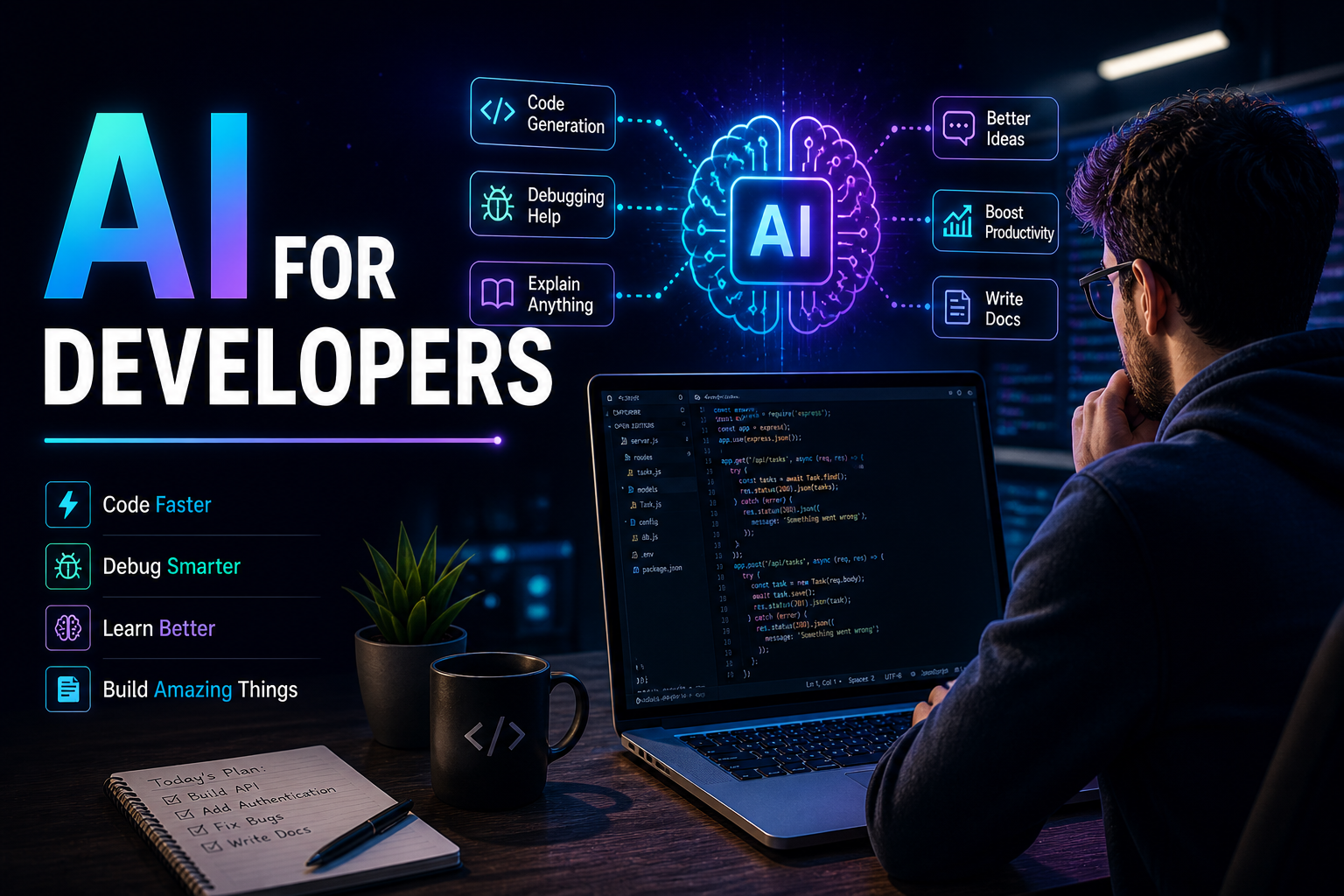
What is AI for Developers?
- Code snippets
- Documentation
- Debugging suggestions
- UI components
How Does Generative AI Work?
Where Are People Using Generative AI?
- Writing and Content Creation: Writers use it to draft blogs, social posts, headlines, and email copies. It helps when you are stuck staring at a blank screen.
- Design and Images:It is used by designers and artists to produce concept art, posters, illustrations, and thumbnails. Without investing hours in each graphic style, someone establishing a YouTube channel can quickly test them all.y.
- Programming: Developers use Generative AI to write code, debug errors, and explain functions. It is like having a coding assistant who never gets tired of answering questions.
- Business and Customer Support: Businesses use it to generate reports, summarise meetings, compose customer responses, and automate tedious tasks. Teams can concentrate on more crucial duties as a result of the time savings.
- Learning : Students and self-learners use it to simplify hard topics, generate practice questions, and get explanations in plain language.
Real-Life Example: A Small Business Owner
The Future of Generative AI
The Good Side of Generative AI
- People may become more productive as a result. It may make it easier to be creative. It can assist novices in performing tasks that previously required expert-level abilities. Additionally, it may lessen the sense of repetition at work.
- A person who was once afraid to write can now start with a draft. A student who struggled with an explanation can get it in simpler words. A designer who had five different ideas in mind can test them quickly
- In many ways, Generative AI acts like a creative shortcut. Not a cheat code, but a helper.
The Limits You Should Know
Answers to Common Questions (FAQs)
Generative AI is a type of artificial intelligence that can create new content like text, images, videos, or code. Instead of just analyzing data, it actually generates something new based on what it has learned.
Traditional AI focuses on tasks like prediction, classification, or analysis. Generative AI, on the other hand, creates content. For example, normal AI might detect spam emails, while Generative AI can write an email from scratch.
Content writing , Image & video creation , Coding & software development , Customer support automation , Education & learning
Not exactly. Generative AI is more likely to change jobs rather than replace them completely. It helps people work faster and more efficiently, but human creativity, decision-making, and supervision are still important.
- Writing clear prompts
- Critical thinking
- Basic understanding of the topic
- Ability to edit and refine outputs