





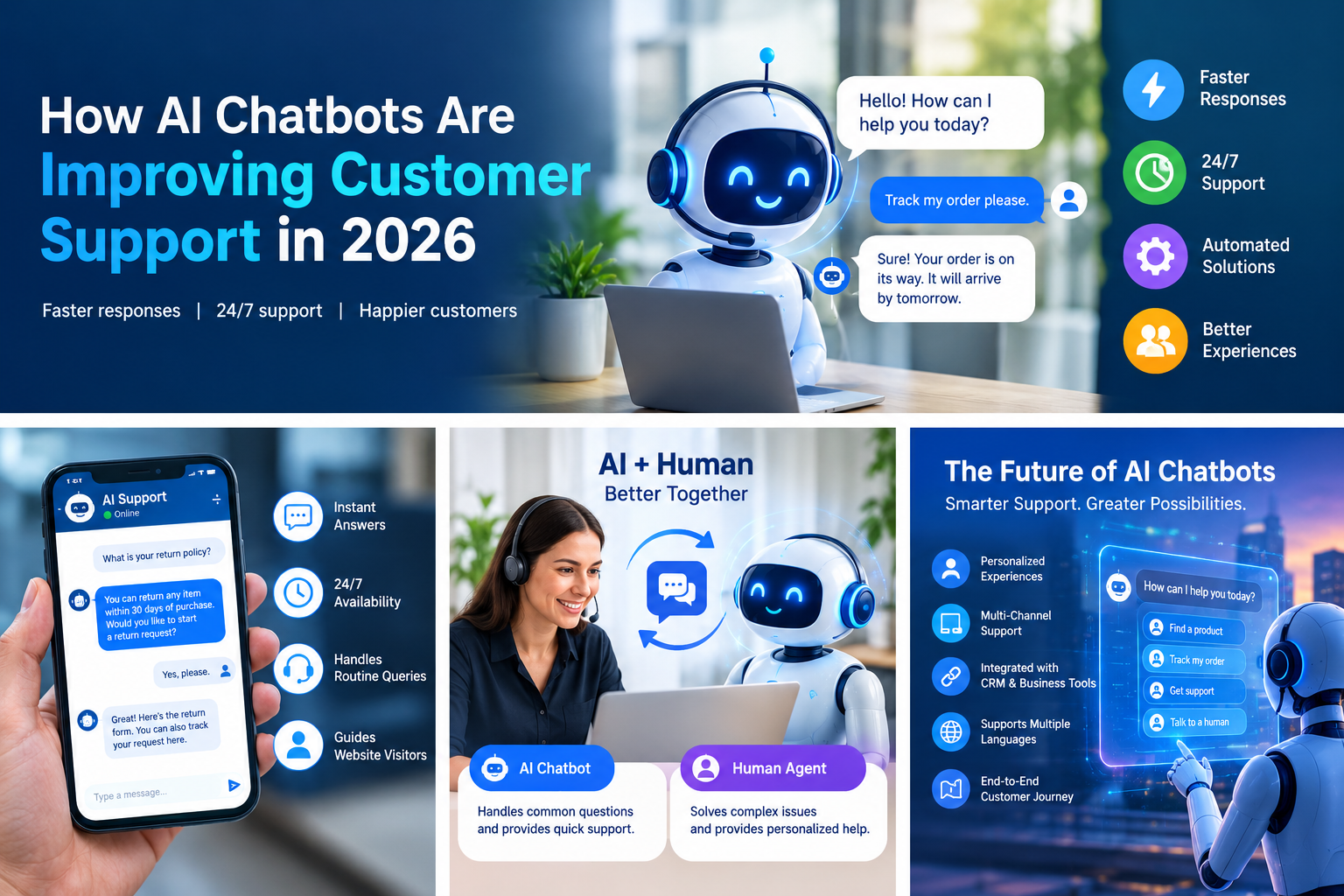
How Are AI Chatbots Improving Customer Support in 2026?
Customers today are becoming more particular about how they want to deal with a brand. For businesses, it can be harder to keep up if the customer needs to always speak with a human being.
This is where AI chatbots are becoming a helpful tool.
In 2026, companies (both big and small) are turning to AI chatbots to answer questions, assist website visitors, address common support issues, and improve customer service teams workflow. AI chatbots are an upgrade compared to older chatbots that rely on pre-set answers. An AI chatbot can interpret a conversation and provide a more relevant experience.
What Is an AI Chatbot?
An AI chatbot refers to a computer program that makes use of artificial intelligence to communicate with an individual via text or voice.
Unlike traditional chatbots, an AI chatbot is more flexible and capable of understanding a conversation. Chatbots used to be quite limiting as they only provided pre-set messages. An AI chatbot can make use of information that is provided to it, as well as, other information that the business has given to it.
For example, instead of a menu that prompts a customer to choose between a few options like:
1. Order Status
2. Return Request
3. Contact Support
An AI chatbot can interpret a customer message and prompt them towards the most relevant information. Instead of asking a customer to “select an option” a customer could write a message such as:
“Can you tell me where my order is?”
Why Are Companies Turning to AI Chatbots in 2026?
Customer support teams are usually faced with hundreds of repetitive questions every day. Common customer questions could include:
Product availability
Pricing
Shippin g
Hours of operation
Refunds
Appointments
Account related
Basic troubleshooting
These are some of the questions that an AI chatbot can answer, saving the time and effort of customer service reps.
1. Faster Responses
Customers usually do not want to wait for a long time for a simple answer. An AI chatbot can provide quicker responses for simple questions when it has been provided with the correct information.
For example, someone visiting a website for an online store could ask:
“Do you deliver on weekends?”
If the company has provided the information about their delivery process to the AI chatbot, then the chatbot could provide the customer with a quicker delivery response than a customer service rep could.
2. 24/7 Customer Support
A human being cannot work 24/7, unlike an AI chatbot. Chatbots can provide assistance to customers 24/7, which can help certain industries that do not always operate during standard business hours.
A customer visiting a website during late hours could ask questions, be provided with information, and even leave inquires or instructions for the next steps they should take. An AI chatbot can do all of this, unlike a customer support team.
3. Repetitive Questions
Customer service representatives often spend hours-a-day answering the same questions.
“What are your business hours?”
“How can I reset my password?”
“What is your return policy?”
“Where is my order?”
An AI chatbot can answer many of these repetitive questions, which can help customer service reps focus on more challenging customer inquiries.
4. Assisting Website Visitors
AI chatbots can also double as website assistants. Instead of a visitor spending hours trying to find the right information, an AI chatbot can assist them.
For example, a website visitor could ask:
“I need a website for my business. Which service should I choose?”
The AI chatbot can ask them a few questions and lead them towards the relevant service or page. This makes the website feel more like an interactive experience.
5. Contextual Conversations
Modern AI systems can make use contextual information to make the conversation feel more relevant to the customer.
For example, if a customer has already asked about a specific product, the AI chatbot can continue to keep the conversation on that product. Businesses can also configure an AI chatbot to know more about their product, service, policies, and more.
It is also important that businesses do not abuse this feature and make sure that they do not collect any unnecessary customer information.
6. Supporting Human Customer Service Representatives
AI chatbots do not always have to support customers. They can also support customer service representatives that handle customer support requests.
A more practical example would be a hybrid approach of an AI chatbot and human customer service rep. The AI chatbot can handle the first part of the conversation and identify the issue before passing it to a human rep for more details. This approach is common with customer support as not every customer requires a human being to handle their request.
Customer → AI Chatbot → Basic Troubleshooting → Human Agent
7. Handling High Volume Customer Support
Some businesses face a high volume of customer support requests. This could happen when a company launches a new product, has an ongoing promotion, holiday sale, or seasonal sale.
A human customer support team cannot handle thousands of customer requests all at once.
An AI chatbot can handle multiple support requests at a time, which is important for businesses that face a high-volume of customer support requests.
8. Multilingual Support
Many businesses are targeting customers from different countries and with different language preferences. AI chatbots can help businesses provide multilingual support to their customers.
For example, a website may have visitors that speak English, Spanish, French, Hindi, and more. This could be helpful for businesses that are targeting international customers. Some businesses should still double-check important translations before publishing it online.
9. AI Chatbots Can Help Generate Leads
An AI chatbot does not always have to be a customer-facing tool. AI chatbots can help a business gather information from potential customers.
For example, a chatbot on a web development website could ask a website visitor the following questions:
What type of website do you need?
What is your estimated budget?
When do you want to start?
What services are you interested in?
This information can then be sent over to a sales rep for further follow up. This way, an AI chatbot also serves as a lead generation tool for the business.
10. Improving the Overall Customer Experience
The ultimate goal of a customer support team is to improve the experience that a customer has when contacting the company. An AI chatbot can help a company improve the overall experience that a customer has with a company.
A well-designed AI chatbot can help customers:
Find the right information faster
Contact the company 24/7
Help them navigate the website
Support them with placing requests
Clarify questions about products and services
Help them get in touch with the right department
All in all, these features can make a customer’s experience more seamless.