





Introduction
Industries have already been revolutionised by artificial intelligence, but a new development called agentic AI is altering how robots communicate, make decisions, and act on their own. Agentic AI systems are able to plan, carry out, and modify activities on their own, in contrast to traditional AI systems that mostly depend on human cues.
Agentic AI is quickly emerging as a key component of contemporary digital transformation, from automating intricate processes to facilitating wise decision-making. This technology is opening the door for smarter, quicker, and more customised solutions across sectors as companies look for efficiency and scalability.
The Rise of Agentic AI in the Digital Era
The use of Agentic AI has increased due to the quick expansion of data, automation requirements, and intelligent systems. Businesses are transitioning from static AI models to goal-driven, dynamic systems that require little human interaction.
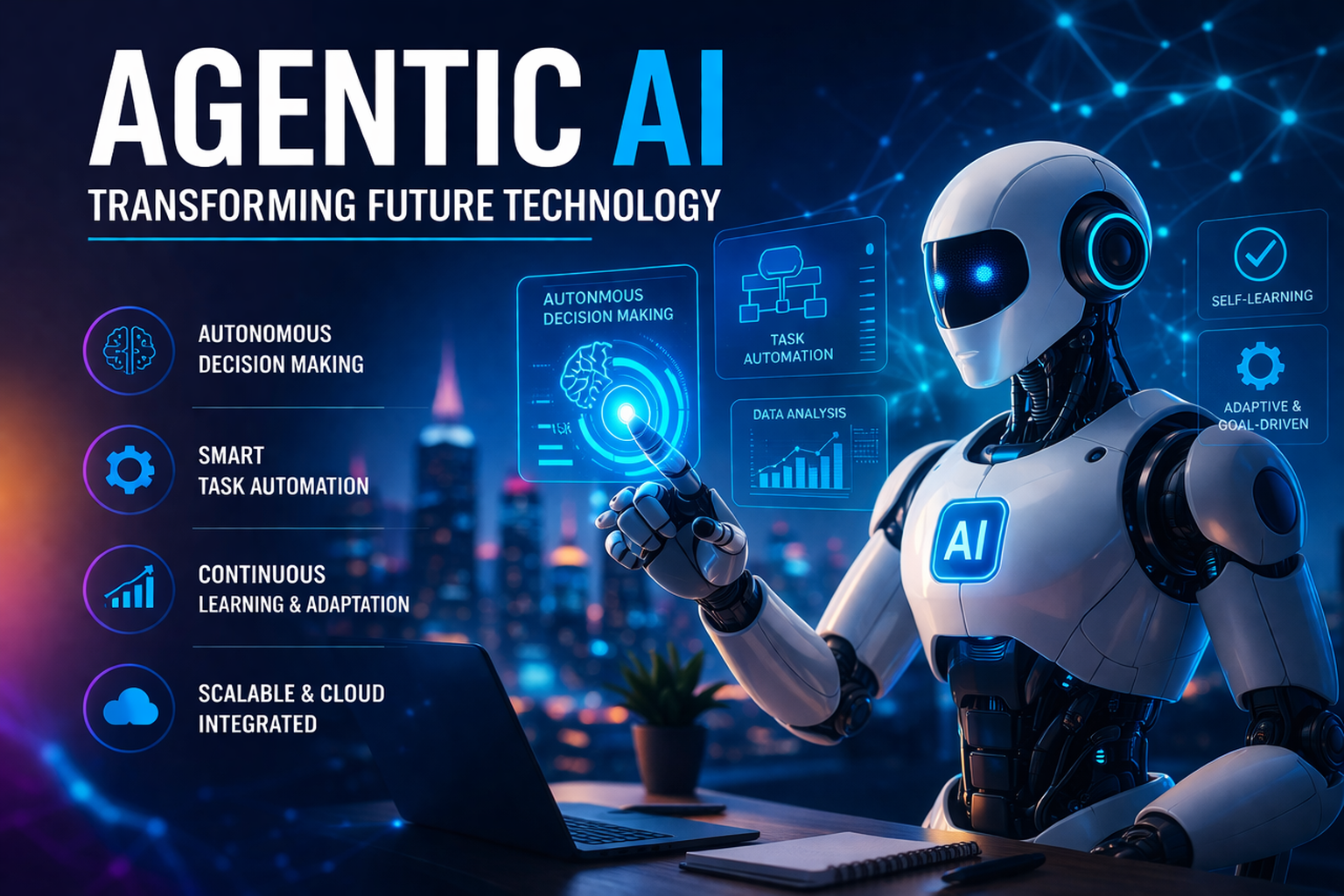
- Autonomous Decision Making: Without continual oversight, agentic AI systems are capable of data analysis and decision-making.
- Task Automation: By managing multi-step procedures, these technologies lower operating expenses and manual labour.
- Continuous Learning: Agentic AI improves performance over time by using data and feedback.
Businesses using Agentic AI gain a competitive edge by increasing productivity and creativity in today’s fast-paced digital environment.
Artificial Intelligence and Autonomous Systems
By adding agency—the capacity to behave freely toward a goal—agentic AI expands on classical AI.
- Intelligent agents are capable of complete task planning and execution.
- Systems offer adaptable solutions and real-time reactions.
- AI agents work together with other systems to finish intricate tasks.
An Agentic AI system, for instance, may answer enquiries, assess sentiment, escalate problems, and even provide solutions in customer service—all without the need for human intervention.
Organisational operations are changing as a result of the transition from reactive to proactive AI technologies.
Agentic AI in Real-World Applications
Agentic AI is currently being used in a variety of businesses and is not only theoretical:
- Healthcare: AI agents provide patient monitoring, diagnosis, and therapy suggestions
- Finance: Fraud detection techniques and automated trading systems function separately.
- E-commerce: Personalized shopping experiences and intelligent recommendations
- Education: Platforms for adaptive learning that modify information in response to student behaviour
These examples show how Agentic AI facilitates scalability, precision, and efficiency in practical situations.
Scalability and Cloud Integration
Because it has access to enormous amounts of data and processing power, agentic AI flourishes in cloud environments.
- Scalability: Systems are able to manage growing workloads without experiencing performance problems.
- Data processing: Analysing big datasets in real time
- Remote Accessibility: Cloud infrastructure enables AI systems to function from any location.
Agentic AI’s capabilities are improved by cloud computing, making it more powerful and accessible for companies of all sizes.
The Future of Agentic AI and Its Role in Innovation
The future of technology is expected to be significantly shaped by agentic AI. As systems evolve, they will make it possible for:
- Completely independent business activities
- Making better decisions with less human involvement
- Improved customisation on all digital channels
- Connectivity to smart gadgets and the Internet of Things
Businesses who invest in Agentic AI now are setting themselves up for a time when intelligent agents will propel efficiency and creativity.
Challenges of Agentic AI
Agentic AI has significant drawbacks despite its benefits:
- Ethical Issues: Guaranteeing Conscientious AI Conduct and Judgement
- Data privacy: safeguarding private user data
- Control and Oversight: Finding a balance between human oversight and autonomous
- Complexity of Implementation: Exorbitant setup and integration expenses
To guarantee the safe and efficient implementation of Agentic AI technology, these issues must be resolved.
The Prospect for the Future
Agentic AI has a very bright future. AI agents will grow more sophisticated, dependable, and incorporated into daily life as technology advances.
Agentic AI will transform how people engage with technology, from smart homes to self-sufficient businesses. Companies who adopt this innovation will be in a better position to lead, grow, and adapt in the digital era.
Answers to Common Questions (FAQs)
AI systems that are capable of acting autonomously, making decisions, and finishing tasks without continual human input are referred to as agentic AI.
While Agentic AI can plan, adapt, and carry out tasks independently, Traditional AI needs instructions.
Numerous businesses, including healthcare, banking, education, and e-commerce, employ it.
Agentic AI may be very successful and safe when used with the right precautions.
Conclusion
The next significant advancement in artificial intelligence is represented by agentic AI, which transitions from passive systems to active, decision-making entities. It is a potent tool for the future because of its capacity to automate difficult processes, adjust to shifting situations, and provide individualised experiences.
Even if there are still difficulties, when done properly, the advantages greatly exceed the dangers. Agentic AI will be essential in creating a more intelligent, productive, and highly automated society as industries continue to change.